
TelEMA LAB / RESEARCH PROJECT
MagneCat
Magnetic insight.
Catalytic discovery.
Modeling Catalytic Nanoparticles via Magnetic Measurements & Machine Learning Techniques

€200k
Project budget
2 years
Research programme
HMU
Host institution
01 / THE RESEARCH CHALLENGE
Understanding catalysts
while they work.
MagneCat measures magnetic fields generated inside working catalytic reactors. It brings together catalysis science and technology with methods for evaluating small magnetic fields developed for space applications.
The aim is to probe the formation and disappearance of magnetic phases during a reaction, helping researchers distinguish complex catalyst deactivation mechanisms.
Why it matters
Catalyst deactivation can limit the commercial deployment of chemical technologies. Several mechanisms may act together, creating a need for advanced in situ and operando characterization.
Magnetic measurements offer a complementary route for investigating these changes alongside established characterization methods, including synchrotron-based studies.
02 / FROM REACTOR TO SIGNAL
A magnetic window into the reaction.

Fluxgate sensing
An array of fluxgate sensors monitors magnetic fields generated and diminished during cyclic reduction–oxidation processes.
Bench-scale experiments
The work begins with bench-scale catalytic reactors. Prof. Yentekakis’ laboratory at the Technical University of Crete provides reactor infrastructure.
The experimental arrangement connects controlled gas delivery, the reactor and downstream detection.
03 / MEASURE • MODEL • VALIDATE
Turning measurements into understanding.
Custom algorithms are validated with test samples, linking measured magnetic signatures to the interpretation of catalytic materials.


04 / RESEARCH INTO PRACTICE
Explore the work.
Discover what comes next.
Quantalyx pitch deck
Explore the project’s innovation perspective through the Quantalyx pitch deck already available in the laboratory’s project archive.
MagneCat workshop
The project workshop was scheduled for 4 November 2025, 11:30–17:30, to present scientific results and research outcomes at the conclusion of the project.
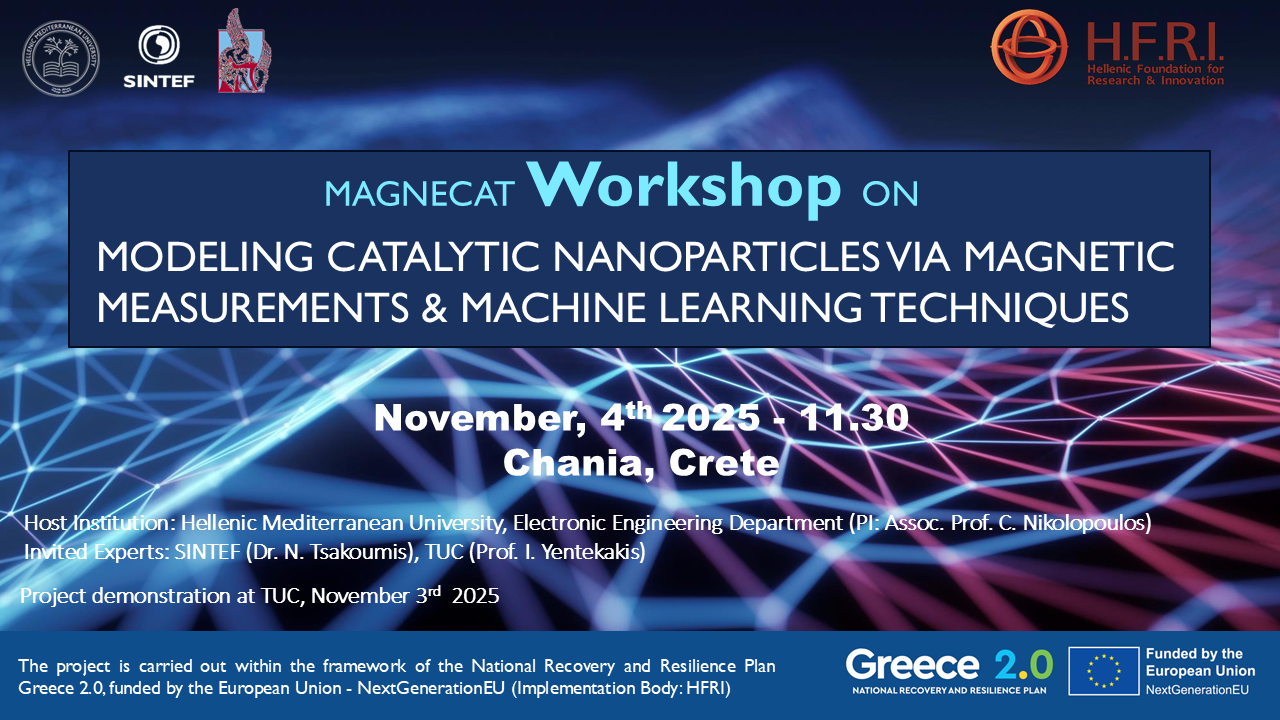

Supported research
The project is carried out within the framework of the National Recovery and Resilience Plan Greece 2.0, funded by the European Union – NextGenerationEU (Implementation Body: HFRI)

Connect with the research team
Interested in magnetic sensing, catalyst characterization or research collaboration?